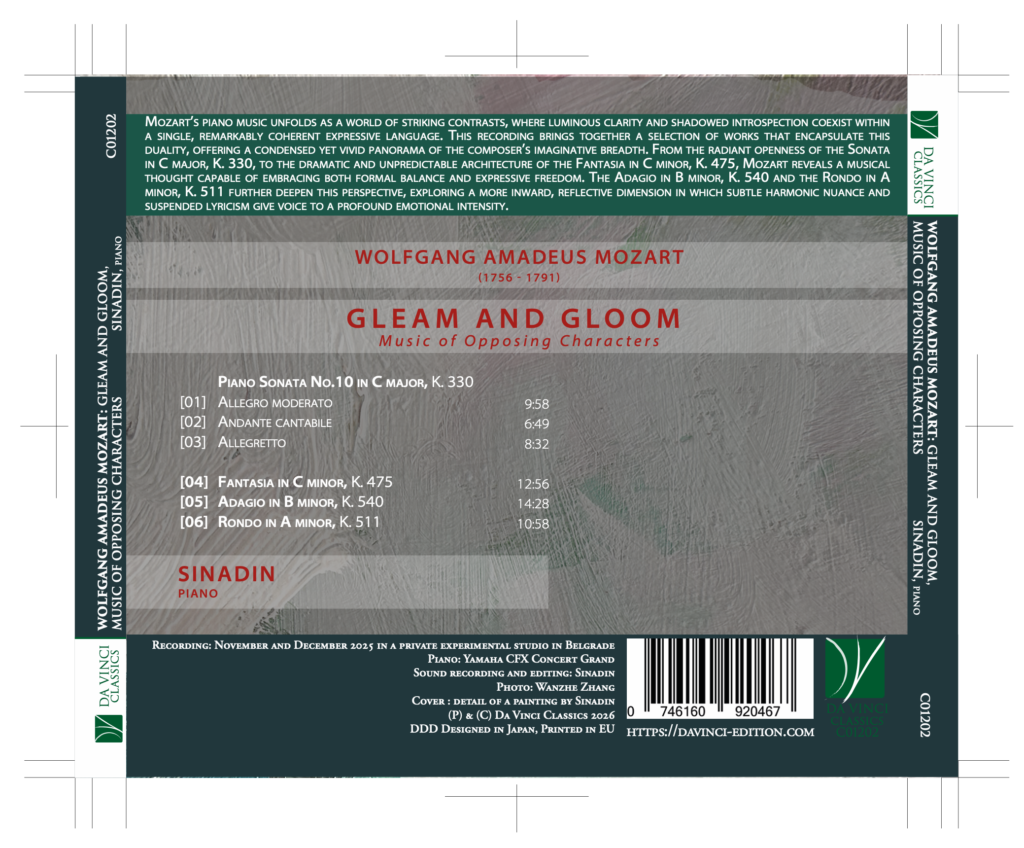
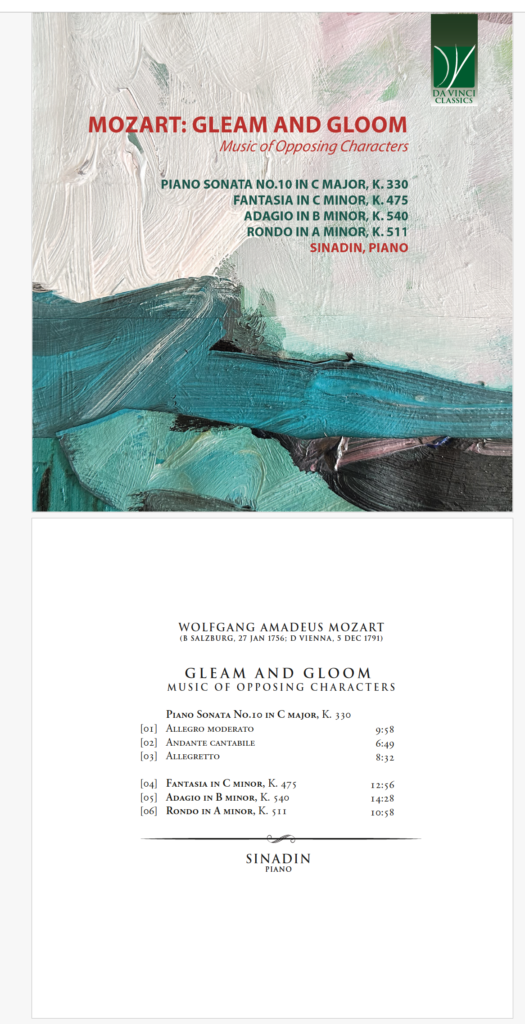
Coming soon: my liner notes for a new CD on Da Vinci Classics.
One of the most striking impressions that emerges when contemplating the entirety of Mozart’s musical oeuvre is the extraordinary diversity of characters and atmospheres that the composer employs as a kind of emotional mise-en-scène for his works. From the exuberant brilliance of a lively Allegro to the shadowy introspection of a minor-key Andante, each composition seems to inhabit its own carefully crafted world, complete with its distinct emotional logic and expressive trajectory. The extreme poles of this remarkably wide expressive spectrum appear almost unattainable, as though they originated from two entirely different stylistic and poetic universes. Yet what is perhaps most surprising is that this diversity does not correspond directly to the composer’s gradual artistic maturation. On the contrary, we occasionally encounter dense layers of darker tonal colouring already in his early works, while his later compositions can radiate a carefree elegance and joyous effervescence that seem to transcend chronological expectation. Mozart’s musical universe thus unfolds simultaneously in multiple directions across time and poetic space; its essential qualities remain constant, resisting any simplistic notion of linear progression or teleological development. This simultaneous layering of contrasts—between early and late, light and shadow, surface and depth—is one of the most fascinating aspects of his art and invites both performers and listeners to explore the multiplicity of expressive possibilities contained within a single musical language.
The selection of works presented on this recording seeks to juxtapose contrasting expressive worlds within Mozart’s piano music, creating within a relatively limited space a vivid demonstration of the depth and richness of these transformations. By placing these pieces in dialogue with one another, the listener is offered a microcosm of Mozart’s creative imagination, a journey across landscapes of temperament, colour, and affect that might otherwise only emerge over the course of a lifetime of engagement with his oeuvre. The interplay between major and minor, between brightness and introspection, is central to this exploration, revealing the subtle ways in which Mozart’s musical thought integrates diverse emotional registers without ever compromising formal clarity or expressive coherence.
For a pianist, there is a particular pleasure in performing music that, within a relatively brief span of time, traverses such a wide spectrum of expressive worlds. An approach of this kind opens a new interpretative horizon, allowing the performer to shape a personal musical voice through which the music may speak with renewed vitality. Each decision of phrasing, articulation, and tonal shading becomes part of a dialogue with the text, a negotiation between the score and the performer’s imaginative sensibility. Both the choice of repertoire and the diversity of interpretative perspectives become essential to this process. When brought together, these elements form a vivid musical panorama—a condensed yet revealing glimpse into the richness and depth of the composer’s creative imagination. This panoramic view allows the performer not merely to play notes, but to inhabit the expressive world of the composer, tracing the subtle transitions between emotional extremes and illuminating the internal coherence of his musical thought.
If, for the purposes of this reflection, we imagine Mozart’s style as a flowing river, then its visible rapids and eddies represent the immediately perceptible surface of that current: the virtuosic passages, sparkling ornaments, and playful thematic turns that delight the listener at first hearing. Beneath it, however, lies a deeper, more mysterious subterranean flow that forms the true foundation of this vast musical world: the intricate architecture of harmony, the subtle motivic interplay, and the philosophical depth that underpins even the most seemingly effortless phrases. A deeper understanding of Mozart’s style emerges only through the exploration of the dialogue between these two currents, through attention to both the surface charm and the profound structural ingenuity that gives his music its enduring vitality and expressive power.
Mozart composed the Sonata in C major, K. 330 at the age of twenty-seven, at a moment when his technical mastery and expressive insight had fully matured. The key of C major embodies the most open resonance within the harmonic spectrum of the overtone series and has long been associated with clarity, luminosity, and the expression of joy in its most unencumbered form. The Sonata’s first movement opens with a confident, lyrical theme, immediately establishing a sense of radiant energy and formal poise. Mozart’s use of articulation, rhythmic subtlety, and sparkling scalar passagework conveys a sense of effortless brilliance, yet beneath this apparent ease lies a meticulous structural logic. The second movement, in F Major with episodes in F minor, introduces contrasting darker hues: shadowy harmonies, expressive suspensions, and poignant melodic turns imbue the movement with a quiet intensity, hinting at the profound emotional undercurrents that coexist with the outer radiance of the work. The final movement, a lively Allegretto, returns to a carefree brightness, yet even here, Mozart intersperses subtle rhythmic surprises and chromatic touches that lend the music a refined expressive complexity. The Sonata K. 330 thus exemplifies the interplay of clarity, wit, and emotional depth, demonstrating how Mozart combines technical mastery with expressive subtlety.
The Fantasia in C minor, K. 475 unfolds in seven distinct sections, each characterized by contrasting tonalities, textures, and affective moods. Its opening theme, unusually structured around seven tones within a framework that traditionally favors symmetry, immediately conveys a sense of unpredictability and expressive tension. The number seven recurs throughout the Fantasia’s intricate textures, reflecting Mozart’s fascination with symbolic and mystical ideas. In January 1785, Mozart had been elevated to the third degree of the fraternity of Ancient Free and Accepted Masons, and he composed this work only a few months later. The proximity of these events suggests that the Fantasia’s symbolic structure may have been influenced by Masonic thought, with seven representing completeness, perfection, and spiritual ascent. Musically, the Fantasia traverses extremes of contrast: stormy, chromatically charged passages alternate with luminous, hymn-like episodes, while virtuosic figurations emerge alongside delicate, almost improvisatory gestures. For the performer, the challenge lies in maintaining coherence across these contrasts, shaping the overarching narrative while preserving the spontaneity and immediacy that give the work its improvisatory character. The Fantasia K. 475 stands as a testament to Mozart’s imaginative freedom and his ability to fuse symbolic depth with expressive virtuosity.
Across cultures, the number seven has long carried symbolic weight. From mythology and numerology to religious and philosophical thought, seven signifies completeness and cosmic order. It appears in the seven colors of the rainbow, the seven days of the week, and the celebrated Seven Wonders of the World. In Western music, the number structures the diatonic scale and informs the perception of tonal balance. Within the Judaeo-Christian tradition, it pervades both narrative and doctrine: the seven days of Creation, the seven deadly sins, the seven sacraments, and the visionary imagery of Revelation, with its seven stars, trumpets, seals, angels, and churches. Comparable structures appear across other traditions: the seven rays of the sun and seven Adityas in Hindu cosmology, the seven factors of Enlightenment in Buddhism, and the ritual circling of the Kaaba in Islam. Seen from this perspective, Mozart’s use of the number seven in the Fantasia is not merely a formal device but part of a broader symbolic language that resonates with the philosophical and spiritual ideas circulating in 18th-century Vienna.
The Adagio in B minor, K. 540 belongs to the more introspective current of Mozart’s keyboard works. Here, Mozart’s expressive palette shifts toward contemplation and subtle emotional depth. The movement is remarkable for its profound lyricism, refined harmonic shading, and an almost meditative pacing that suspends the sense of linear time. Every interval, every pause, seems carefully measured to reveal psychological nuance and intimate reflection. For the performer, the Adagio demands restraint, sensitivity, and a careful balance between tonal warmth and expressive intensity. Its understated grandeur reveals Mozart’s ability to convey profound emotion without resorting to overt virtuosity, a quality that distinguishes his mature minor-key writing.
The Rondo in A minor, K. 511 complements the Adagio, extending the introspective discourse while introducing elements of rhythmic vivacity and thematic contrast. The recurring rondo theme carries a somber, almost elegiac character, while the episodic interludes explore tonal and emotional extremes. The movement’s structural clarity, combined with its expressive intensity, offers the performer the opportunity to shape a nuanced dramatic arc, negotiating tension and release, light and shadow, with careful attention to the subtleties of touch and timing. The Rondo K. 511 thus exemplifies how Mozart’s minor-key works can convey both intellectual rigor and deeply human emotion, creating an inwardly directed, reflective musical world that engages the listener on multiple levels.
Taken together, the works on this recording form a miniature panorama of Mozart’s pianistic universe. Between the luminous openness of the C-major Sonata, the dramatic and symbolically charged architecture of the C-minor Fantasia, and the inward, meditative atmospheres of the two minor-key works, we encounter a dialogue between light and shadow, extroversion and introspection, surface brilliance and hidden depth. Within this tension between contrasting expressive forces, Mozart’s artistic language reveals its most profound truth: a musical world in which joy and melancholy, clarity and mystery, intellect and intuition coexist as complementary dimensions of a single, endlessly fascinating creative vision. It is precisely this capacity to encompass the breadth of human emotion and imagination within a coherent, luminous musical discourse that continues to captivate performers and listeners alike, offering a glimpse into the inexhaustible richness of one of history’s greatest creative minds. Each of these works, in its particular expressive domain, illuminates a different facet of Mozart’s artistry, revealing both the formal mastery and the poetic imagination that make his keyboard music eternally compelling.
Prof. Dejan Sinadinović